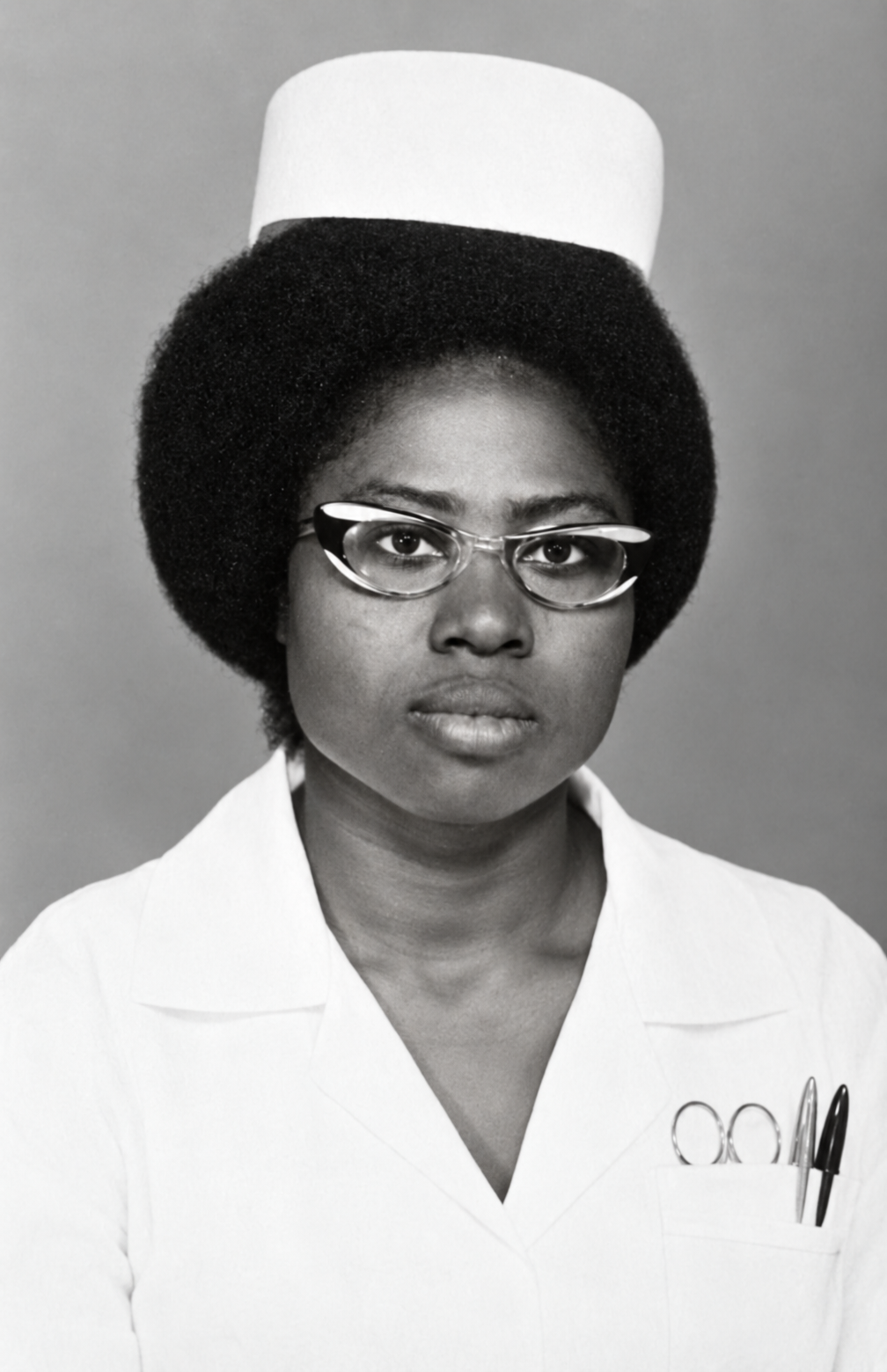
Life & Legacy
A story of courage, education, faith and the transformative power of opportunity.
Elder (Mrs) Grace Flora Oji Bakpa · Born 5 May 1942
ELDER (MRS) GRACE FLORA OJI BAKPA
A Life That Defied the Limitations of Her Time
A Story of Courage, Education, Faith, Love and the Transformative Power of Opportunity
Born 5 May 1942 — A Legacy That Lives On
There are lives that history remembers for the positions their owners occupied, and others whose true significance lies in the obstacles they overcame and the lives they quietly transformed. The story of Elder (Mrs) Grace Flora Oji Bakpa belongs to the latter.
She was born at a time when a young girl’s future was often imagined for her long before she was old enough to imagine it for herself. Yet, through an uncommon combination of intellectual brilliance, perseverance, faith and the encouragement of those who believed in her, she crossed the boundaries of expectation to become a distinguished nurse, healthcare leader, devoted wife and mother, and a source of hope to many.
Her story is not simply a celebration of personal achievement. It reflects the circumstances that shaped the lives of countless Nigerian women of her generation and reminds us that talent, however extraordinary, cannot flourish without opportunity.
It is also the story of how one young woman’s determination would, many decades later, inspire a foundation dedicated to opening doors for others.
CHAPTER I — A GIRL WHO DARED TO DREAM
Childhood, Education and the Courage to Challenge Expectations
On 5 May 1942, in Sapele, a bustling commercial town in what was then colonial Nigeria, Grace Flora Oji was born into the family of Chief Luke Joe Igben of Ekpan, in present-day Uvwie Local Government Area of Delta State, and Mrs Uwejoma Anna Joe Igben (née Owereh) of Ovu, in Agbon Kingdom.
Sapele was a town of commerce, cultural encounters and changing possibilities. Its waterways connected communities, while colonial trade, missionary activity and emerging educational institutions were gradually reshaping the social landscape.
Yet beneath these changes lay a society in which the opportunities available to children were far from equal.
In the Nigeria of the 1940s and 1950s, Western education was becoming an increasingly important pathway to professional advancement. For many families, however, educating a child beyond the elementary level required considerable financial sacrifice. Where resources were limited, sons were often given priority, particularly because they were expected to become future providers and bearers of family responsibilities.
For girls, the expectations were frequently different.
A daughter’s upbringing was commonly understood in relation to marriage, motherhood, domestic responsibilities and the preservation of family values. Although missionary schools had begun to provide important educational opportunities for girls, advanced schooling and professional training remained beyond the reach of many.
These expectations were not universal, nor did every family share them equally. Nevertheless, they formed part of the social environment into which Grace was born.
Grace began her formal education at Convent Girls Elementary School, Sapele, in 1949.
From an early age, she displayed an exceptional aptitude for learning. Her academic performance consistently distinguished her from her contemporaries, earning her the affectionate nickname “Magnetic Brain”, a tribute to her remarkable memory and intellectual ability.
Her teachers, particularly the Catholic Reverend Sisters, recognised in her a child of uncommon promise.
An accomplished young athlete, particularly in sprinting, she also represented her school in competitive sporting events, demonstrating the energy, discipline and determination that would later characterise her professional life.
Her academic excellence earned her admission to St Anne’s School, Ibadan, one of the respected institutions for girls’ education in West Africa. For a young girl from Sapele, such an achievement was remarkable.
Yet Grace did not take up her place. The prevailing preference for daughters to remain closer to home influenced the course of her education.
Instead, with her father’s approval, she continued her studies at Our Lady of Apostles Girls Secondary School, Sapele, from 1954 to 1959.
There, her brilliance continued to shine. She completed her secondary education with distinction, and her abilities were sufficiently recognised for her to be offered an opportunity to remain at the school as a member of its support teaching staff.
But Grace had another ambition.
She wanted to become a nurse.
Nursing represented more than employment. It offered the possibility of professional independence, dignity and an opportunity to serve humanity.
In 1959, aged seventeen, she passed the entrance examination for nursing training.
In a more equitable world, that achievement might have been sufficient to secure her future.
But her father, Chief Luke Joe Igben, initially refused permission for her to proceed.
His decision was shaped by the social expectations and economic considerations of the period. He feared that the demands of a nursing career might interfere with his daughter’s prospects of marriage and motherhood. With several children requiring support, he also chose to direct the family’s available resources towards the education and advancement of her brothers.
For Grace, the disappointment was profound.
She had worked diligently, passed the examination and demonstrated her ability. Yet the opportunity remained beyond her reach.
She had not failed.
Rather, the limitations of her time threatened to deny her the future she had earned.
Faith, Discernment and the Courage to Try Again
Grace’s formative years were deeply influenced by the Catholic faith.
Raised as a devout Catholic, she developed a profound admiration for the Reverend Sisters who taught and guided her. To the young Grace, these women represented something extraordinary: they were educated, disciplined, independent-minded and wholly devoted to serving God and humanity.
At a time when opportunities for women were often constrained by traditional expectations, the Reverend Sisters embodied a different possibility — a life defined by knowledge, purpose, spiritual conviction and service.
They became her earliest role models.
When her father refused permission for her to pursue nursing, Grace began seriously contemplating a different calling.
She considered becoming a Reverend Sister.
For a young woman whose life had been deeply influenced by Catholic education, religious life offered a meaningful possibility. The Reverend Sisters were the women she admired most, and their devotion reflected many of the qualities she hoped to cultivate in herself.
She approached the Reverend Mother and expressed her desire to enter religious life.
The response she received would become another defining moment in her journey.
Rather than immediately welcoming Grace into the convent, the Reverend Mother offered counsel marked by wisdom and discernment.
She encouraged Grace to continue her education and pursue her professional ambitions before making such a profound and lifelong commitment.
Religious vocation, she advised in essence, should arise from genuine spiritual conviction rather than disappointment or the frustration of other aspirations.
Grace should complete her education first. If, after doing so, she remained truly convinced that religious life was her calling, the opportunity to pursue that path would remain open to her.
It was advice that recognised both the seriousness of religious commitment and the importance of allowing a young woman to discover her own future.
The Reverend Mother did not dismiss Grace’s spiritual aspirations.
Instead, she gave her something equally valuable: the freedom to discern her calling without surrendering her education.
Encouraged by this guidance, Grace renewed her determination to become a nurse.
In 1960, she sat the nursing entrance examination again.
Once again, she passed.
Her father, having witnessed the disappointment caused by his earlier refusal and the persistence of his daughter’s ambition, eventually reconsidered his position.
Chief Luke Joe Igben gave his consent and financial support for her nursing education.
His change of heart deserves an important place in this history. It would be too simple to portray him merely as an obstacle to his daughter’s advancement. He was also a man living within the conventions of his generation, confronting a changing world in which traditional expectations were increasingly being challenged by education and professional opportunity.
By reconsidering his decision, he helped make possible a future that his earlier judgment had threatened to close.
In 1961, Grace entered the School of Nursing, Ibadan.
The young girl whose ambitions had nearly been brought to an end was finally able to begin the professional journey for which she had worked so hard.
Her story reminds us that encouragement can restore hope, but opportunity is what allows hope to become achievement.
And the young woman who had once contemplated entering a convent would eventually discover that her calling to serve humanity could find expression beyond its walls.
Back to chapters ↑CHAPTER II — A LIFE DEDICATED TO HEALING
Professional Achievement, Pioneering Service and Leadership in Healthcare
Grace qualified as a Registered Nurse in 1963, at a defining moment in Nigeria’s national history.
The country had attained independence only three years earlier. Its institutions were expanding, and the need for educated Nigerians to contribute to healthcare, education, administration and national development was increasingly urgent.
Women were participating in this transformation, although they continued to encounter social and institutional barriers.
Grace belonged to a generation whose professional achievements helped challenge the assumption that women’s contributions should remain largely confined to the domestic sphere.
Following the creation of the Mid-Western Region in 1963, she was posted to the General Hospital in Benin City, beginning what would become a distinguished career in public healthcare.
Her commitment to professional development continued.
In 1965, she obtained her Midwifery qualification, becoming both a Registered Nurse and a qualified Midwife.
In doing so, she became one of the earliest professionally qualified nurses from her community in what is today Uvwie Local Government Area of Delta State.
This was no small achievement.
For a woman whose professional future had once been questioned because of expectations surrounding marriage and family life, her qualification represented both personal fulfilment and a quiet challenge to the limitations placed upon women of her generation.
It demonstrated that a daughter from Ekpan could pursue professional training, enter the healthcare workforce and make a meaningful contribution to society.
But Grace’s significance lay not simply in becoming a pioneer.
It lay in what she did with the opportunity she had received.
A Lifetime in the Service of Others
Grace’s nursing career carried her across different regions of Nigeria.
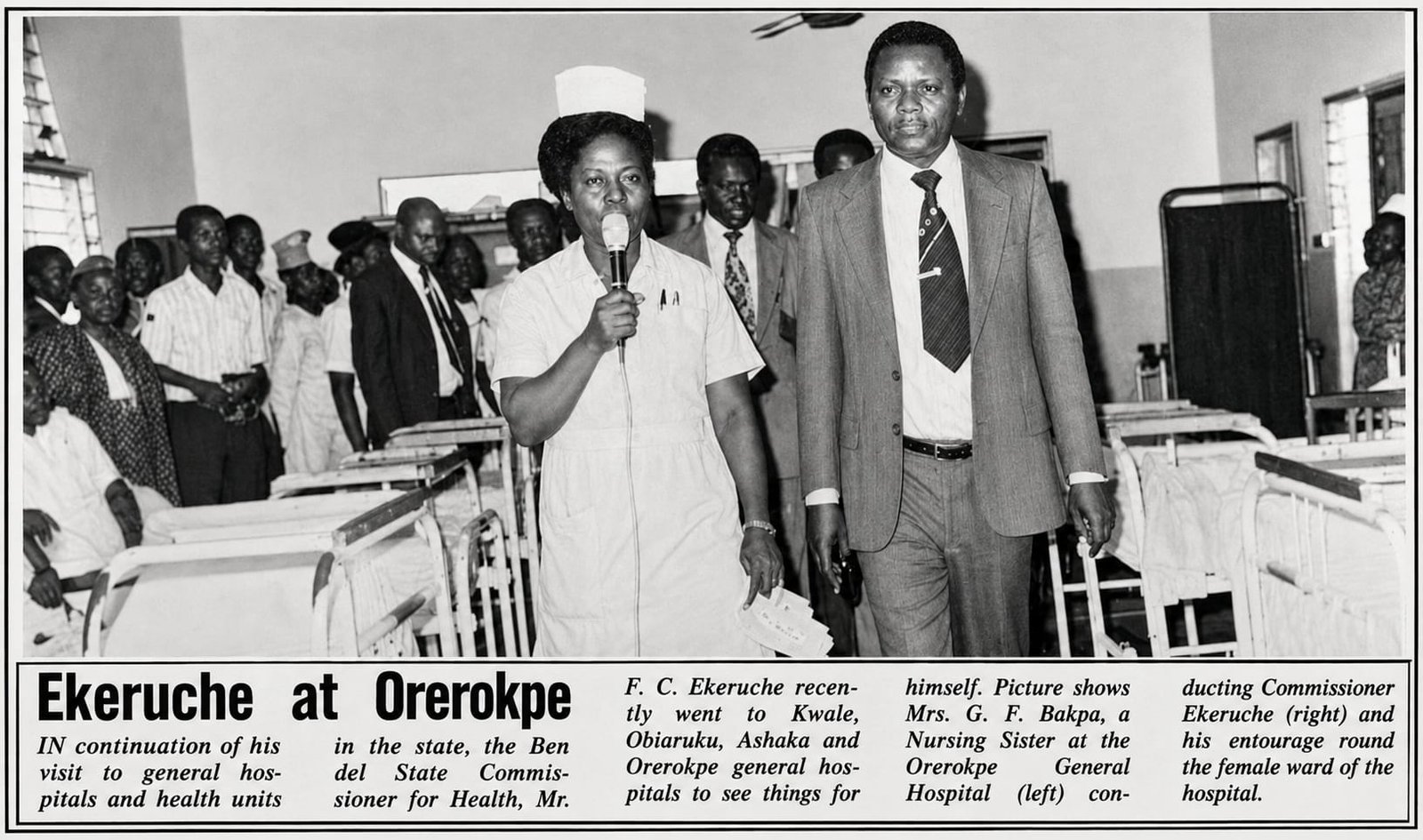
Her professional assignments included Asaba, Benin City, Warri, Sapele, Eku, Auchi, Bomadi, Orerokpe and Maiduguri.
These were communities with differing social circumstances, healthcare needs and institutional resources. Across them, she contributed her professional knowledge and experience to the care of patients and the development of healthcare services.
Nursing demands a particular form of human commitment.
It requires technical competence, but it also calls for patience in the presence of suffering, composure in moments of distress and compassion towards people whose vulnerability places them in the care of others.
For Grace, the profession became a lifelong expression of service.
She continued in government healthcare until 1981, when she joined the Nigerian National Petroleum Corporation (NNPC) as one of its pioneer nurses in the then Bendel State.
Her career at NNPC reflected the increasing importance of professional healthcare within Nigeria’s expanding industrial and petroleum sectors.
Through experience, dedication and professional leadership, she rose to the position of Chief Health Superintendent, serving as the most senior Nursing Officer and heading NNPC Medical Zonal Units.
She retired from active service in 1997, after more than three decades devoted to healthcare.
The significance of that career is best appreciated when considered alongside its beginnings.
The girl who had once been denied permission to train as a nurse had become a senior healthcare professional entrusted with leadership responsibilities.
The daughter whose education had initially been considered less deserving of investment had devoted her working life to the welfare of others.
Her journey illustrated an enduring truth: when society invests in the education of a woman, the returns are not confined to her personal advancement. They extend to families, institutions, communities and future generations.
Yet there was much more to Grace than the distinguished professional life she built.
Beyond the hospitals and medical institutions, another important story was unfolding.
It was the story of Grace the woman, wife and mother.
CHAPTER III — LOVE, MARRIAGE AND A HOME OPEN TO ALL
An Extraordinary Meeting, a Lasting Partnership and the Meaning of Family
In 1964, while serving as a young nurse at Eku Baptist Hospital in the newly created Mid-Western Region of Nigeria, Grace experienced an encounter that would profoundly shape the course of her personal life.
Among the patients rushed to the hospital for medical attention was Chief Bernard Baro Bakpa, popularly known at the time as Hon. B. B. Bakpa, a prominent businessman and politician serving as a parliamentarian in the newly established Mid-Western Region of Nigeria.
Grace was the nurse placed directly in charge of his care.
It was while attending to his medical needs and overseeing his nursing care that their paths first crossed.
Neither could have known that this encounter would mark the beginning of a lifelong partnership.
There was something particularly remarkable about the circumstances.
Only a few years earlier, Grace had contemplated dedicating her life to religious service as a Reverend Sister, following the disappointment of being denied permission to pursue nursing.
The Reverend Mother had wisely encouraged her to complete her education first and allow her future vocation to emerge through genuine conviction rather than disappointment.
Grace followed that advice.
She pursued her education, qualified as a nurse and began the professional journey for which she had fought so determinedly.
And it was through that very profession that she encountered the man who would become her husband.
The young woman who had once considered the quiet devotion of convent life discovered that love and service could also find expression in marriage and family.
What began as a professional encounter between a dedicated young nurse and a patient gradually developed into a personal relationship and ultimately marriage.
Together, Grace and Bernard built a family and a home characterised by hospitality, generosity, encouragement and community service.
Their marriage endured for 43 years, until Chief Bernard Baro Bakpa’s passing in 2010.
In retrospect, there is a profound beauty in the unfolding of Grace’s journey.
The profession her father had initially feared might interfere with her prospects of marriage became the very pathway through which she met her husband.
And the values she had admired in the Reverend Sisters — faith, compassion, discipline and service — remained central to the life she built as a wife, mother and healthcare professional.
Grace’s story demonstrated that a woman’s education need not stand in opposition to marriage, motherhood or faith.
Rather, education could deepen her capacity to embrace each of these responsibilities with confidence, independence and purpose.
A Mother Beyond Her Own Children
For Grace, however, family extended far beyond the boundaries of her immediate household.
Her home became a place of welcome for relatives, friends and others who sought assistance, guidance or reassurance.
She supported widows, encouraged younger people and extended care to those who were not related to her by blood.
To many, she became a mother in every meaningful sense of the word.
Her compassion was not an occasional act of generosity. It was woven into the ordinary conduct of her life.
The same instinct that had drawn her into nursing found expression in the way she welcomed people, listened to their difficulties and responded to their needs.
Her professional calling and her personal character were, in this respect, inseparable.
She understood that compassion was not measured solely by what one possessed, but by the willingness to share whatever was available.
Her life as a wife and mother therefore became another expression of the values that had shaped her professional and spiritual journey.
Back to chapters ↑CHAPTER IV — FAITH, COMPASSION AND A MOTHER TO MANY
An Enduring Reverence for God and a Lifetime of Christian Service
Throughout her life, Elder (Mrs) Grace Flora Oji Bakpa was a woman of profound Christian conviction.
Her faith was neither a passing influence nor a mere expression of religious affiliation. It was the foundation upon which she built her character, guided her decisions and understood her responsibilities towards others.
Grace always revered God.
From her earliest years, she possessed a deep sense of reverence for the Almighty, a quality that remained constant through the changing seasons of her life.
Raised as a devout Catholic, her formative years were profoundly influenced by the Reverend Sisters who guided her education. Their discipline, devotion and commitment to serving humanity left an enduring impression upon her young mind.
Indeed, such was her admiration for their way of life that she once contemplated entering the convent herself.
Although her journey eventually led her towards nursing, marriage and motherhood, the spiritual values she absorbed during those early years never departed from her.
As her life unfolded, Grace’s Christian faith found further expression through the Pentecostal movement, marking another significant chapter in her spiritual journey.
Her Pentecostal journey began at Word of Life Bible Church, where she became a devoted member for just over a decade.
During those years, she deepened her commitment to Christian fellowship, biblical teaching, prayer and spiritual growth.
Her association with the Church reflected a sincere desire to strengthen her relationship with God and to live according to the teachings of Christ.
She subsequently became a member of Living Faith Church, popularly known as Winners Chapel, where she remained a devoted member for approximately twenty years before her demise.
Throughout these years, Grace’s dedication to her Christian faith remained steadfast. She participated actively in church life, encouraged fellow believers and offered spiritual guidance to those who sought her counsel.
Her knowledge of the Bible was remarkable.
Through years of dedicated study and devotion, she developed an extraordinary familiarity with Scripture, earning from those who knew her the affectionate description of a “walking Bible.”
Yet what distinguished Grace was not simply her ability to recall biblical passages.
It was her determination to put the principles of her faith into practice.
She understood Christianity as a calling to compassion, humility, generosity, forgiveness and service to humanity.
Her reverence for God was reflected in the respect she showed to others, the kindness she extended to those in difficulty and the dignity with which she treated people regardless of their circumstances.
Her home became a place of welcome, encouragement and refuge. She offered support to widows, guidance to young people and comfort to those confronting life’s uncertainties.
There was a remarkable consistency between the young Catholic girl who admired the Reverend Sisters, the woman who embraced Pentecostal Christianity, and the compassionate mother and healthcare professional who devoted her life to others.
Her places of worship changed over the decades, but her reverence for God and her commitment to humanity remained unwavering.
In many respects, Grace’s life came to embody the ideals that had first inspired her as a young girl: faith expressed through action, knowledge placed in the service of others, and a willingness to respond to human suffering with compassion.
She did not ultimately become a Reverend Sister.
Instead, she became a nurse, a wife, a mother, a mentor and a woman whose life touched many others.
Her vocation took a different form, but the spirit of service that inspired it endured.
For Grace, faith was never simply about the church one attended or the Scriptures one could recite.
It was about how one lived, how one treated others and what one contributed to the world.
And perhaps that was the most enduring expression of her lifelong reverence for God: she sought to honour Him not only through worship, but through the life she lived and the love she gave.
Back to chapters ↑CHAPTER V — HER LEGACY, THEIR OPPORTUNITY
From One Woman’s Journey to a Lasting Commitment to Education and Healthcare
The story of Elder (Mrs) Grace Flora Oji Bakpa is not simply a remembrance of a remarkable woman.
It is a story about opportunity.
It is about a young girl born into a society where the ambitions of daughters were frequently constrained by expectations they had little power to challenge.
It is about a gifted student whose intellectual promise was recognised by teachers who believed that her future deserved to be nurtured.
It is about a father who, despite the conventions of his generation, found the willingness to reconsider an earlier decision and support his daughter’s professional aspirations.
And it is about what became possible because that opportunity was given.
Grace went on to become a Registered Nurse and Midwife, a pioneering healthcare professional, a senior nursing leader, a devoted wife and mother, a woman of faith and a source of encouragement to countless people.
But her greatest contribution cannot be measured solely through professional qualifications, titles or years of service.
It is found in the lives she touched and the possibilities her example continues to inspire.
From Personal History to a Shared Mission
The circumstances that nearly prevented Grace from becoming a nurse have not disappeared entirely from contemporary society.
Across Nigeria, children and young people continue to face barriers to education, professional development and access to essential healthcare.
Many possess extraordinary potential but lack the financial resources, encouragement or institutional support necessary to realise their ambitions.
Some dream of becoming nurses, doctors, teachers, scientists or community leaders.
Others have not yet discovered what they might become.
Their futures should not be determined solely by the circumstances of their birth.
It is from this conviction that the Grace Bakpa Heritage Foundation was established.
Created in honour of Elder (Mrs) Grace Flora Oji Bakpa, the Foundation seeks to transform the values that defined her life into practical opportunities for others.
Its work is grounded in three interconnected commitments: education, healthcare and partnerships.
Through nursing scholarships, educational support, community healthcare initiatives and strategic collaboration, the Foundation aims to remove barriers that prevent disadvantaged individuals from fulfilling their potential.
Its guiding philosophy reflects the very circumstances that shaped Grace’s life.
A young woman who was almost denied the opportunity to become a nurse would eventually inspire an organisation committed to helping others enter the healthcare profession.
A mother whose home welcomed those in need would become the inspiration for programmes designed to support vulnerable families and communities.
And a woman whose life demonstrated the transformative power of education would leave behind a legacy dedicated to making education accessible to others.
The Foundation’s commitment to the United Nations Sustainable Development Goals — Quality Education (SDG 4), Good Health and Well-being (SDG 3), and Partnerships for the Goals (SDG 17) — gives practical expression to these principles.
But beyond institutional objectives lies a deeply human purpose.
Somewhere in Nigeria today, there is a young girl with the intelligence and determination that Grace possessed.
She may dream of becoming a nurse.
She may have passed an examination but lack the resources to continue her education.
She may be waiting for someone to believe in her future.
What she needs may not be an extraordinary intervention.
It may simply be a scholarship, a mentor, access to healthcare or an opportunity that allows her abilities to flourish.
Grace was once that young girl.
Someone believed in her.
Someone gave her another chance.
And she devoted her life to making a difference.
Through the Grace Bakpa Heritage Foundation, her story now offers others the possibility of shaping their own futures.
Her greatest legacy is therefore not only the life she lived, but the lives that may yet be transformed because hers was lived.
A Legacy of Hope
Somewhere in Nigeria today, there is a child with extraordinary promise whose circumstances offer little encouragement.
Perhaps she dreams of becoming a nurse, as Grace once did. Perhaps he hopes to become a doctor, a teacher, an engineer or a scientist. Perhaps neither has yet discovered what is possible.
What they need may not be a miracle.
It may be a scholarship. A mentor. A word of encouragement. Access to healthcare. Or simply someone willing to believe that their future matters.
Grace was given the opportunity to become the woman she was capable of being.
Through her legacy, we seek to ensure that others are given the same chance.
Her Legacy, Their Opportunity.
Grace Bakpa Heritage Foundation
Empowering Dreams. Elevating Healthcare. Transforming Lives.
Back to chapters ↑Music for reflection
Take a quiet moment with these two treasured hymns. Choose a track and press play.
Amazing Grace
Clarinet, piano and pipe organ · 3:09
“Amazing Grace 2011” by Kevin MacLeod · CC BY 4.0. Recording unchanged.
Abide with Me
Solo organ · 0:54
“Eventide” (Abide with Me), performed by The Uninvited Co., Inc., © 2005 · CC BY-SA 2.5. Recording unchanged.